
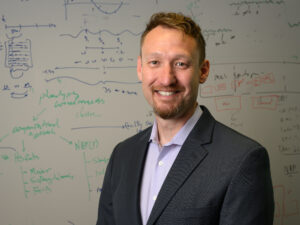
Boswell Presidential Chair of Neuroscience and Society and Wells Fargo Faculty Scholar Ken Kishida poses for photos at his lab at One Technology Place in Downtown Winston-Salem on Friday, June 6, 2025.
Professor of Biology
Boswell Presidential Chair in Neuroscience and Society
B.S. in Genetics, Minor in Philosophy: Univ. of California, Davis, 1999
Ph.D. in Neuroscience: Baylor College of Medicine, 2006
office: 108 Winston Hall
email: kishidk at wfu dot edu
Areas of interest:
Neurobiology of human decision-making, learning, and consciousness; Neuromodulatory signaling in humans (e.g., dopamine, serotonin, norepinephrine); Neurocomputational representations of human experience.
Research:
My lab uses direct intracranial recordings of neuromodulators (e.g., dopamine, serotonin, and norepinephrine), with sub-second temporal resolution, during awake conscious behavior to investigate how these key neurotransmitters affect choice behavior and subjective reports of phenomenal experience in humans. These investigations are guided by computational models, which describe both theoretical models of choice behavior and hypotheses about how specific signals may drive subjective phenomenal experience in humans.
We also employ high-dimensional data science methods to characterize patterns and relationships in our data which are derived from multiple levels of investigation of human participants including: intracranial sub-second neurochemical fluctuations, non-invasive BOLD imaging (fMRI) data, dynamic behavioral tasks, and clinical characterizations (including present clinical profile and patient history). We are not clinical scientists per se, rather basic neuroscientists who study humans in clinical spaces where the full spectrum of human phenomenal experience and willful choice are enriched, but to date under-studied and not well characterized. We hypothesize the existence of ‘computational phenotypes’, which we believe can quantitatively characterize dynamic processes supported by neurobiological systems, resulted from biological natural selection on evolutionary timescales, and ought to have an observable (thus discoverable) neural and genetic infrastructure.
Short Summary of our research:
#WalkWithWente: https://
Best of Deans Research Symposium (Wake Forest University School of Medicine) – Neurosurgery: https://player.
Training and Mentorship Approach:
I take a highly individualized approach to mentorship. I seek out diversity (racial, ethnic, cultural, and academic expertise/training) in my mentees. My approach is informed by my own experiences, which represents a non-traditional academic path from “at risk youth” to tenured associate professor at a major medical research institution. I identify as mixed-race, am a first-generation college student, and was raised by a single parent in a very diverse community. I have witnessed friends and classmates enter the juvenile legal system in middle school and high school. I have experienced what it is like to struggle to find one’s way through academics without mentorship (nearly impossible, but for some luck) and the tremendous acceleration that is possible when one is fortunate enough to come across a caring and effective mentor. I continue to further develop my mentorship approach through coursework and workshops aimed at developing best practices in mentorship methods. Additionally, I seek direct feedback from my mentees and use this information to grow and adapt to my mentees needs.
At each major transition in my research and scientific training (undergraduate to graduate to postdoctoral to faculty) I changed my methodological focus. While I was always focused on a particular scientific question, I changed research methodology in order to pursue the level of investigation I believed would be most fruitful. I started with an interest in genetics and philosophy (of mind), transitioned to molecular and behavioral neurobiology (in rodents), and then again transitioned to computational neuroscience and human cognition.
Now, I use my highly collaborative and internationally recognized research program to promote my mentees and create professional networks for them to grow within and thrive scientifically and professionally.
At every stage, I have been challenged with learning very different ways of thinking and attacking problems (e.g., scientific, and personal/professional). This has given me a unique breadth of expertise that allows me to engage with mentees from many backgrounds and levels of expertise and meet them with an individualized mentorship approach. I also recognize that a mentee’s goals may change over time and so I regularly meet with mentees and adapt our mentorship/mentee-ship goals to ensure that we are maximizing our time together and preparing the mentee for the next stages of their career. I work side-by-side with my mentees (weekly meetings) to work through problems and challenges and try to create a space where we are learning together.
Publications:
https://scholar.google.com/